Measure customer satisfaction.
RihlaCustomer journey mapping and measurement platform
A better customer experience does not start with a survey, but with understanding the journey. Map your customer’s journey, measure every touchpoint, and uncover opportunities for improvement in one platform.
Sadaa's leading clients

















Manage the experience in one place
Why use a platform built specifically for customer experience?
Many organisations rely on separate tools for satisfaction measurement, data analysis, and journey mapping. The result is fragmented information and slower decisions.
Rihla brings the essential customer-experience tools together in one platform, helping you:
Understand the customer journey.
Analyse customer feedback.
Track customer-experience metrics.
Identify opportunities to improve.
Make decisions grounded in data.
01Features
What can you do with the Rihla platform?
Rihla provides all the tools you need to manage customer experience, from creating surveys and mapping customer journeys to measuring performance indicators, analysing data and sentiment, and uncovering insights that help you continuously improve the experience.
1
Customer-experience surveys
Create custom surveys for every stage of the customer journey, distribute them through multiple channels, and collect responses in real time.
2
Customer journey mapping
Map the customer journey visually, define touchpoints, and connect every stage to the right performance metrics.
3
Customer-experience metrics
Track metrics including:
- Customer satisfaction (CSAT)
- Net Promoter Score (NPS)
- Customer Effort Score (CES)
- Response time
- Customer retention rate
- And more.
4
Customer feedback analysis
Analyse written responses using sentiment and keyword analysis to uncover the real reasons behind customer satisfaction or dissatisfaction.
5
Real-time dashboards
Track customer-experience performance through interactive dashboards that help management teams make faster decisions.
02Product
Everything you need to measure experience, intelligently.
From building the tool to the final insights — a quick tour inside the Sadaa platform.
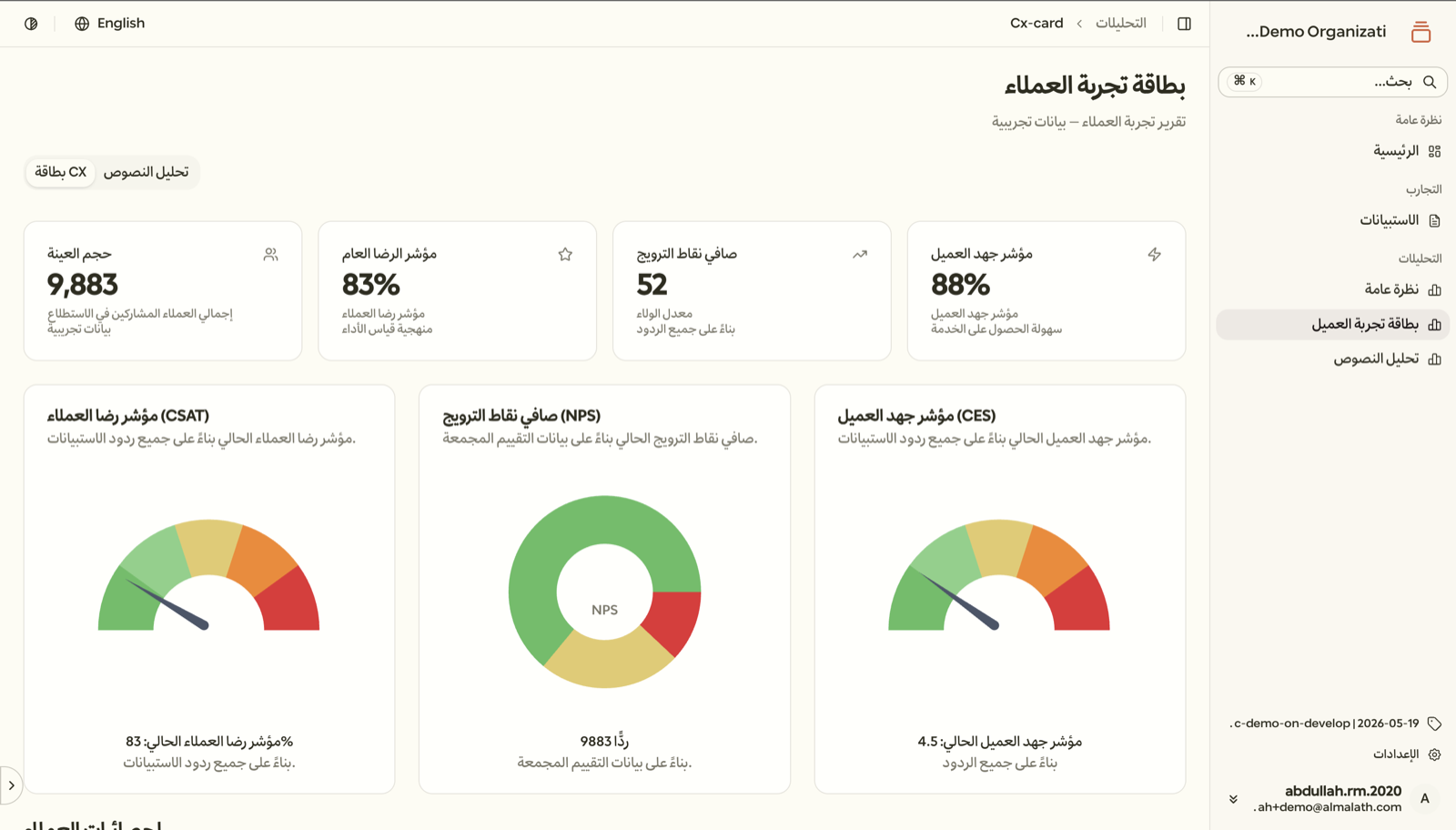
CX CARD
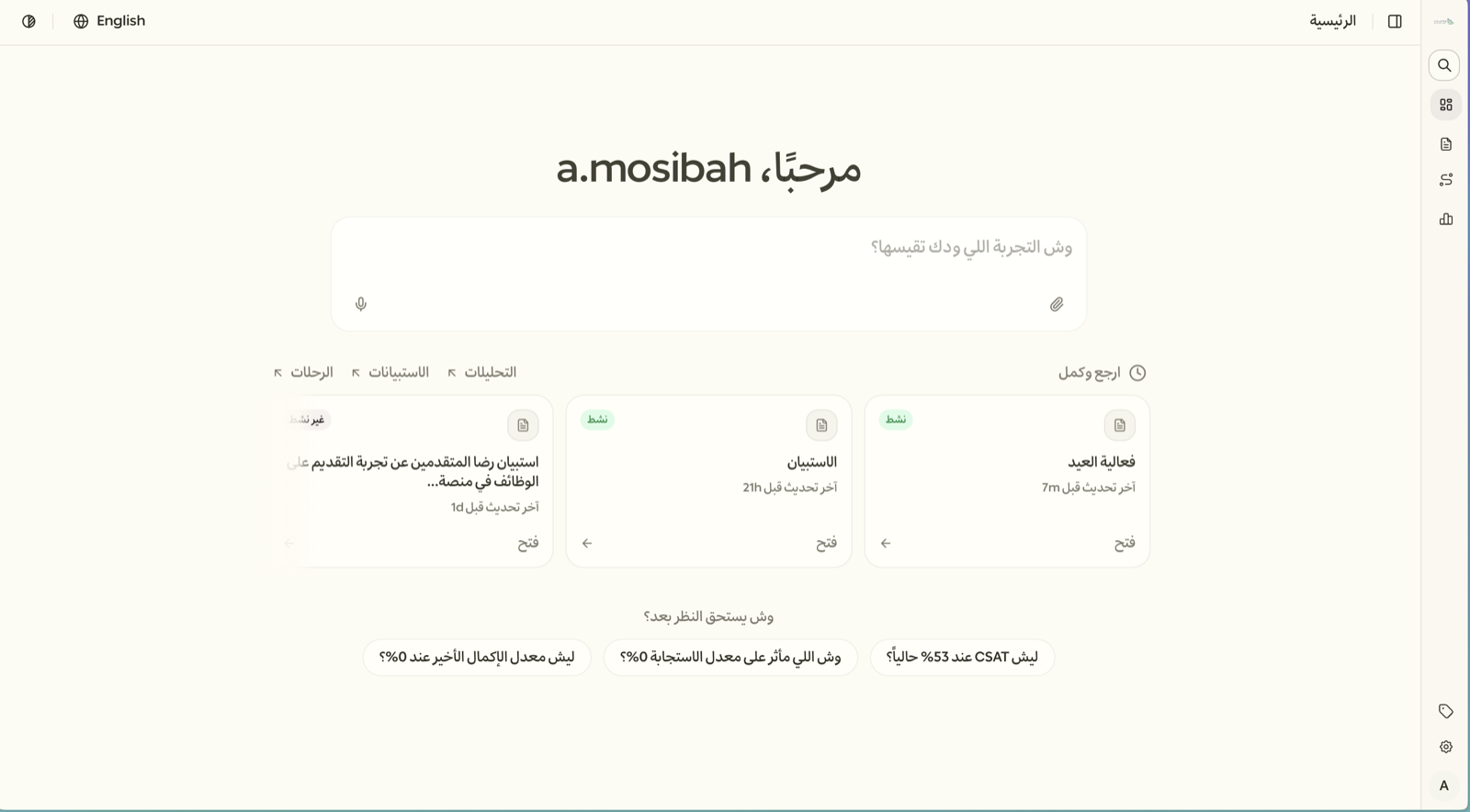
Customer experience at a glance
CSAT, NPS, and CES metrics gathered on one screen, with sample size and the meaning of every number.
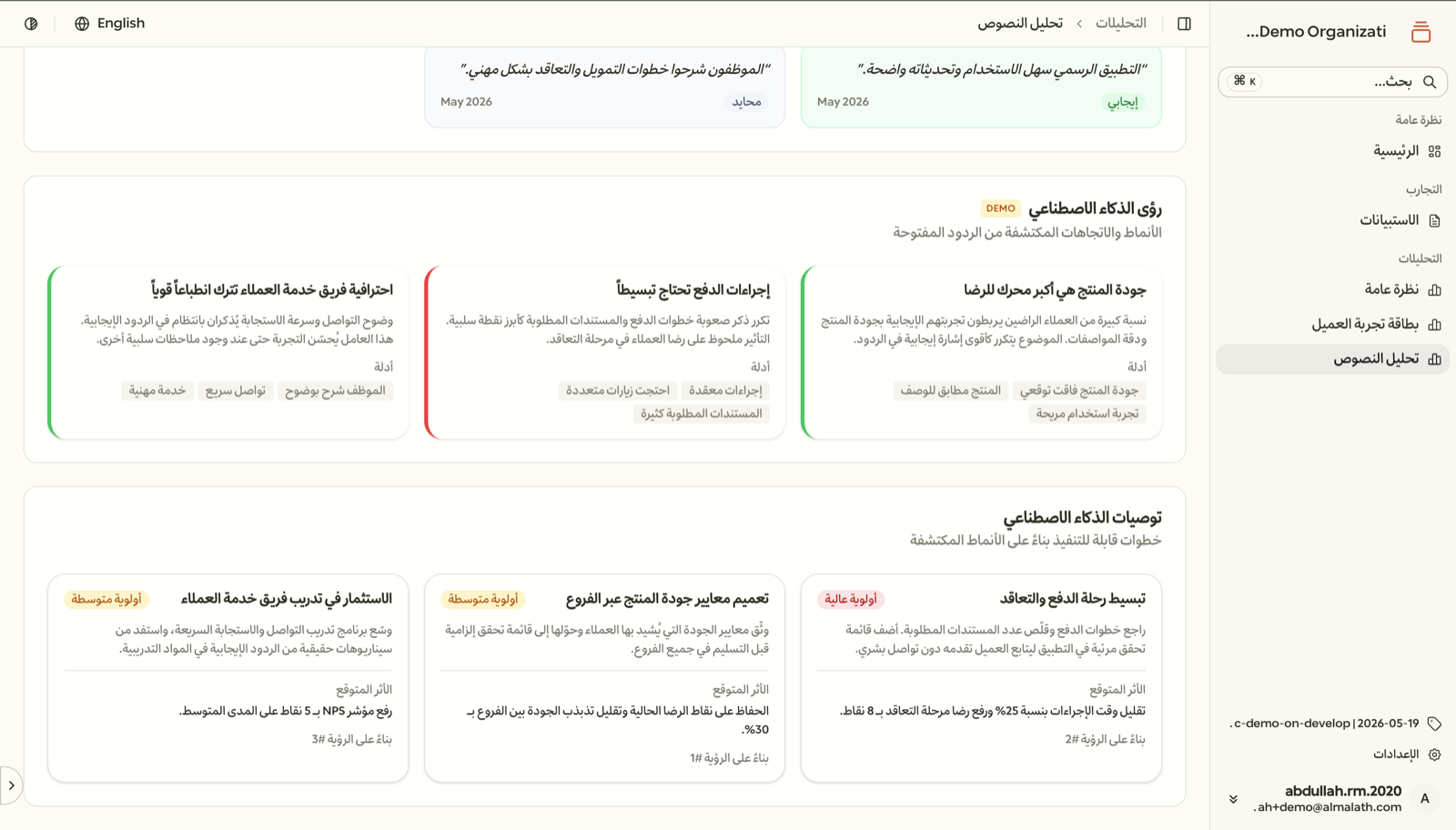
AI INSIGHTS
Insights and recommendations, written for you
The platform discovers patterns in open-ended responses and proposes actionable, priority-ranked next steps.
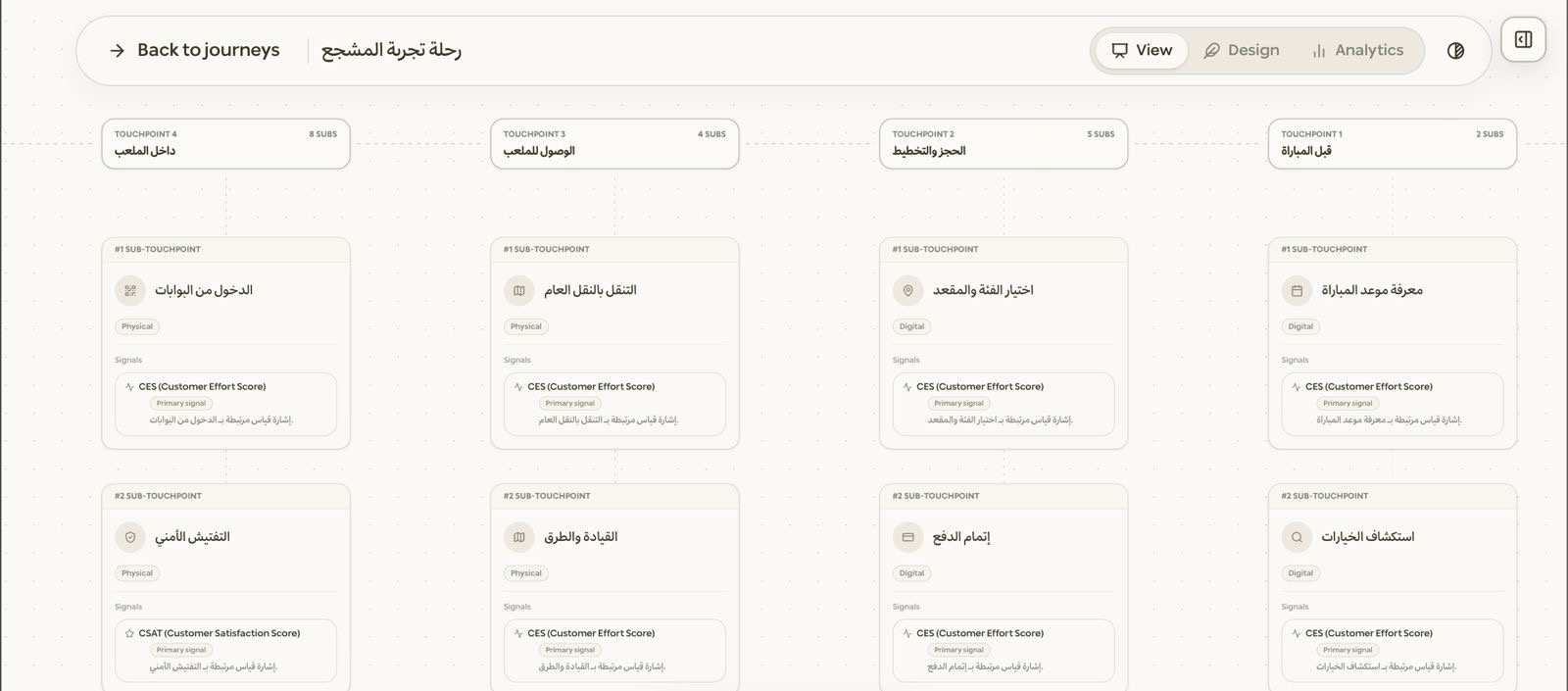
JOURNEY MAP
Measurement tied to every touchpoint
A journey map links each metric to a real touchpoint — digital or in the field — so you know exactly where things break.
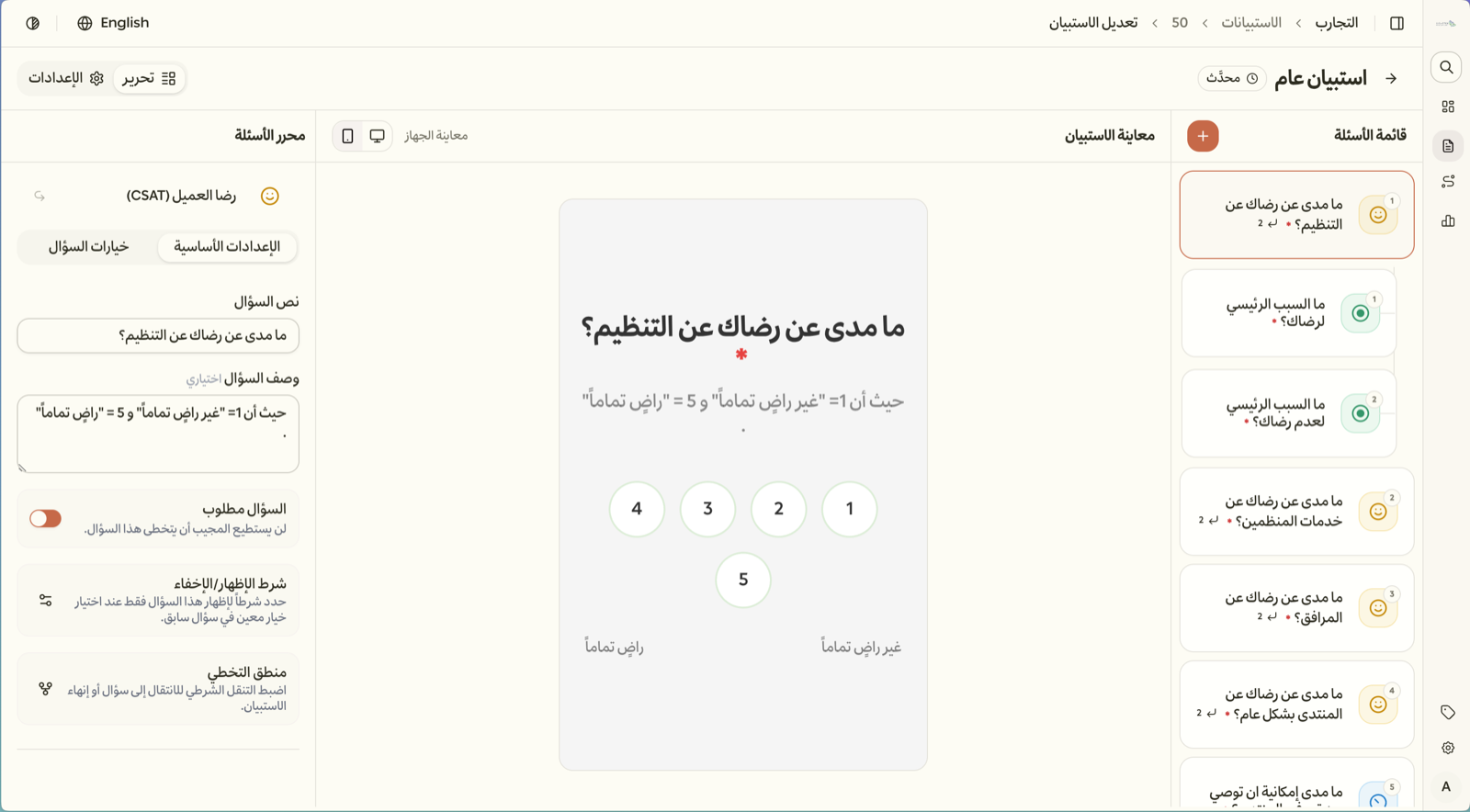
SURVEY BUILDER
Measurement tools built in minutes
A visual editor for CSAT, NPS, and CES questions with live preview, skip logic, and display conditions.
AI SURVEY BUILDER
An AI-tailored survey
Describe the experience you want to measure in your own words, and the AI studies your organisation's context, field, and past surveys to design a ready-to-publish survey.
Compare the approaches
Do you need several tools to manage customer experience?
Many organisations use separate systems for surveys, data analysis, journey mapping, and reporting.
Each tool may serve a purpose, but the combination often fragments data, makes connections harder to see, and adds time and cost before a team can reach an insight or decision.
Sadaa is designed to bring those customer-experience tools together, so data, metrics, journeys, and surveys work as one system.
Why choose a specialised platform?
Because customer experience is more than a survey.
It starts with understanding the customer journey, selecting the right measurement points, collecting and analysing data, turning it into insight, and tracking the effect of improvements over time.
Keeping those steps in one platform makes customer-experience management more precise and less complex.
Separate tools
Rihla platform
Surveys
Standalone tool and isolated data
Connected to a stage and touchpoint
Customer journey
A map separated from measurement
Every stage linked to its metric
Metrics
Reports split across teams
CSAT, NPS, and CES in one view
Text analysis
Manual exports and processing
Text and sentiment analysis in the platform
Decisions
Manual joins and delayed visibility
Dashboards and actionable insights
03The journey
An end-to-end measurement journey inside Sadaa.
1
Design the tool
Build the survey
2
Launch measurement
Multi-channel rollout
3
Collect responses
In real time
4
Analyse results
AI-powered
5
Decision support
Actionable recommendations
04Sectors
Who uses Rihla?

Government customer experience

Hospital customer experience

Event customer experience

Tourism customer experience
AlsoMuseum customer experienceRestaurant customer experienceRetail customer experienceSports club customer experience
By the numbers · tangible impact
Measurement that proves its impact at scale.
From a single measurement to deep language analysis — Sadaa handles thousands of responses and turns them into clear themes and metrics.
9,883
participants in a single measurement
A real sample size that proves readiness at scale.
+1,200
free-text responses analysed
AI language analysis for every open-ended reply.
15
themes discovered automatically
Topics the AI identifies from customers' own words.
0.82
average sentiment score
On a 0-to-1 scale across all responses.
We gather customer voice from every touchpoint and turn it into clear metrics that drive the decision in time.
5Integrated measurement stagesFrom designing the tool to decision support.
+4Collection channelsLinks · QR codes · kiosks · digital channels.
3Standard metricsCSAT · NPS · CES, ready to measure.
Insights
Essential customer-experience concepts
Practical definitions to help you decide what to measure, when to measure it, and how to interpret the result.
Customer experience is the impression a customer forms through every interaction with an organisation, from first awareness and purchase or service use to what happens after the experience ends.
It is shaped by more than product or service quality. Access, clarity, response time, communication, problem resolution, and the emotions a customer carries away all contribute.
Organisations that focus on customer experience therefore look beyond satisfaction scores. They seek to understand why customers feel the way they do and improve the experience continuously.
A customer journey is the complete set of stages a customer passes through when dealing with an organisation, from first considering a service to the end of the relationship.
It includes touchpoints such as visiting a website, contacting support, going to a branch, or using an app.
Journey mapping helps an organisation understand what customers experience at every stage, find pain points, and identify opportunities for a smoother and more satisfying experience.
Customer-experience measurement is the process of collecting and analysing customer feedback and data to understand the quality of the experience an organisation provides.
It goes beyond sending a survey after a service. It can include surveys, comment analysis, performance metrics, and sentiment analysis at different stages of the customer journey.
Measurements become more accurate and useful when they are connected to the journey.
Customer Satisfaction Score is one of the most widely used customer-experience metrics. It measures satisfaction with a specific service or experience.
CSAT is usually collected after a touchpoint such as a purchase, branch visit, or support interaction, giving the organisation a direct signal about that moment.
The score alone does not explain the reason for satisfaction or dissatisfaction, so it works best alongside qualitative questions and feedback analysis.
Net Promoter Score measures how willing a customer is to recommend an organisation or service to others.
It is commonly used as a loyalty signal because it looks beyond satisfaction with a single moment and considers the likelihood of an ongoing relationship.
It can help organisations understand the strength of their brand and experience relative to alternatives.
Customer Effort Score measures how easy or difficult it is for a customer to receive a service or complete a task.
Lower effort generally supports a better experience. Organisations use CES to find complicated processes and steps that cause friction or frustration.
A survey is only one part of a customer-experience system.
To understand an experience accurately, organisations need to connect surveys to the customer journey, analyse written feedback, link results to metrics, and track performance over time. That is how feedback becomes a practical decision.
05Trust
Trust built on real use across major national projects.
From entertainment to the Hajj and Umrah seasons to the non-profit sector — measurement that proves its impact where experiences are many and channels are varied.

Sadaa in the field · the Grand Mosque
FAQ
Frequently asked questions.
Sadaa is a Saudi customer-experience management platform. It brings survey creation, customer journey mapping, performance metrics, data analysis, and actionable insights together in one place.
The Sadaa platform supports government entities, businesses, non-profits, events, tourism facilities, healthcare organisations, educational institutions, and any team that wants to measure and improve customer or beneficiary experience.
Yes. The Sadaa platform lets you create surveys suited to your sector, touchpoint, and customer-journey stage, then distribute them through multiple channels.
Yes. Journey-mapping tools connect every stage with the relevant metrics and surveys, making experience measurement more precise.
The Sadaa platform supports CSAT, NPS, CES, and custom metrics designed around an organisation's needs.
Rihla turns raw data into dashboards and actionable insights. It also analyses written feedback and sentiment to help teams identify the causes behind satisfaction and friction.
Yes. Teams can compare performance across branches, departments, and services, with metrics and reports tailored to each management level.
Yes. Digital and field tools can measure visitor experience at events, conferences, and exhibitions, then turn the results into practical insights.
Yes. Alongside the technology, Sadaa provides consulting for journey design, measurement programmes, experience analysis, performance metrics, and capability building.
Traditional survey tools focus on collecting answers. The Sadaa platform manages the wider customer-experience process, from journey mapping and measurement design to data analysis, insight, and decisions.